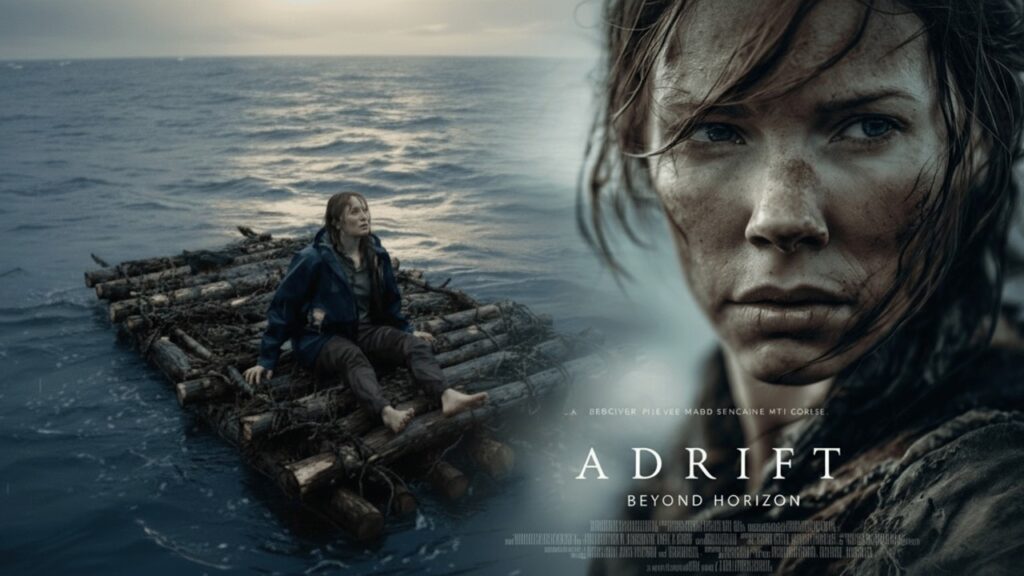
This film is billed as “The Ultimate Survival Epic of 2025.” It centers around Dr. Maya Serrano, a marine researcher, who wakes up alone on a fragile, handmade raft after a catastrophic storm. Cut off from the rest of civilization and surrounded by the endless, unforgiving ocean, Maya’s fight for survival begins. This is not just a physical challenge — she must also navigate her own fears, exhaustion, isolation, and the powerful, often cruel forces of nature.
Parallel to Maya’s struggle, there is a naval search team racing against time. They are trying to rescue her, but their own mission is complicated when they intercept a violent pirate attack on a cargo ship. The tension in the movie comes not only from Maya’s survival predicament but also from the external stakes involving the search crew. Will they save her before she is claimed by the sea? The film weaves these two narratives together into a high-stakes adventure-action thriller.
Genre, Style, and Innovative Aspect
The movie is categorized as survival, action, adventure, thriller, and drama. But what makes it especially noteworthy is its AI-powered production. According to the video description, “Adrift: Beyond Horizon” was generated with cutting-edge tools — notably Google Veo 3.1 — marking a bold step into a new era of filmmaking. It’s not just a survival movie; it’s a statement about how AI can contribute meaningfully to creative storytelling.
The runtime is roughly 70 minutes, which is shorter than many traditional feature films, but long enough to immerse viewers in Maya’s harrowing journey.
Emotional & Thematic Depth
At its heart, this is a story of resilience. Maya’s ordeal is not only a physical fight against the ocean, but also a mental and emotional battle. The film invites viewers to reflect on themes like isolation, human willpower, and self-discovery. The description draws parallels to films such as The Revenant in terms of raw emotional survival and Cast Away when it comes to loneliness and the struggle against a vast, indifferent nature.
Maya’s journey is symbolic of how, when stripped of everything, humans must rely on their own resourcefulness, grit, and hope to survive. The storm that leaves her adrift represents both literal and metaphorical chaos — she has to rebuild, not just her raft or her direction, but her spirit.
On the other side, the naval search team and the pirate subplot raise the stakes beyond her personal struggle. It’s not a solo survival tale: the movie explores how others risk everything to save her, as well as how unexpected violence (the pirate attack) can pose additional threats when rescue seems imminent.
Cinematic & Visual Impressions
Because this film is AI-generated, one might expect visually rich and possibly experimental imagery. The channel description suggests that the creators are pushing boundaries: using AI to render water, storms, and survival scenarios. The sea is likely to be a character in itself — unpredictable, beautiful, and deadly. The handmade raft, the endless horizon, and the open water give a sense of scale and vulnerability, showing how tiny Maya is in the face of nature.
The video’s description encourages viewers to reflect on their own experiences: “What moment in Maya’s struggle hit you the hardest? And if you were stranded, what’s the ONE essential item you’d want on that raft?” This invites emotional engagement and personal connection, further amplifying the survival theme.
Why It’s Interesting / Worth Watching
- Innovative Filmmaking: The fact that this is an AI-powered movie makes it fascinating from a technical and creative perspective. It shows how artificial intelligence can help create full, feature-length films.
- Survival Drama: Survival stories have a timeless appeal — watching someone battle against nature, isolation, and hopelessness is inherently gripping.
- Emotional Journey: Beyond just action, Maya’s emotional arc — dealing with loneliness, fear, and presumably hope — gives the story depth.
- Adventure + Action: The dual narrative with the naval team and the pirate subplot adds variety and tension. It’s not just one person vs. nature, but a more layered conflict involving rescue and external threats.
- Accessible Length: At 70 minutes, it’s relatively short, making it more accessible than long blockbusters — but still rich enough to deliver a full narrative.
Audience & Who Might Enjoy It
- Fans of survival movies like Cast Away or All Is Lost.
- Viewers interested in AI and futuristic cinema, who want to see what’s possible with generative technology.
- Action-adventure lovers who appreciate both natural and human-driven conflict.
- People who enjoy character-driven stories and emotional challenges, especially ones that focus on resilience.
- Those curious about experimental or independent filmmaking.
Questions & Reflections
- How realistic is Maya’s survival scenario? Would a marine researcher really be able to survive that long on a raft?
- What moral or philosophical questions does the movie raise about human dependence on technology, or how we face nature?
- In what ways does the AI-generation of the film affect our emotional connection to Maya and her world? Does knowing it was made by AI change how we feel about her struggle?
- Could there be a sequel or follow-up, perhaps focusing on what happens after rescue or exploring other survival stories?
Conclusion
ADRIFT: Beyond Horizon (2025) is a bold and ambitious film that combines the adrenaline of action-adventure with the intimacy of a survival drama. Its use of AI in filmmaking makes it especially noteworthy, pushing the boundaries of what movies can be in the near future. Through the journey of Dr. Maya Serrano, the film explores human strength, vulnerability, and the power of hope when all seems lost. If you’re drawn to stories of survival, innovation, and emotional endurance, this is definitely a YouTube movie worth checking out.